


For decades, holograms have served as a visible marker of authenticity. A product with a holographic label was often perceived as genuine and for a long time, that perception was enough.
However, the landscape has changed.
Today, relying on conventional hologram stickers as a primary security feature is no longer sufficient. With the rapid advancement of replication technologies, what once symbolized protection is increasingly becoming just a visual element, one that can be imitated with surprising accuracy.
And counterfeiters are fully aware of this shift.
The Changing Face of Counterfeiting
Counterfeiting has evolved from low-quality duplication to highly sophisticated replication.
Modern counterfeiters now have access to:
- AI-powered tools capable of recreating intricate designs
- Advanced image processing software that enhances scanned outputs
- High-resolution printing systems that can reproduce fine details with precision
As a result, the visual gap between genuine and counterfeit products is narrowing at an unprecedented pace.
This evolution has significantly reduced the effectiveness of traditional 2D/3D holograms when used in isolation.
Why Precision and Resolution are Now Critical
In today’s security environment, precision is the defining factor.
High-resolution mastering, reaching 600,000 DPI and beyond, is no longer considered a premium feature. It is rapidly becoming the baseline requirement for effective brand protection.
At this level of precision:
- Critical design elements are too fine to be accurately captured by standard scanning devices
- Replication of microstructures becomes extremely complex and resource-intensive
- Even advanced duplication attempts fail to match the original integrity
This is where holography transitions from being a visual deterrent to a true security mechanism.
Understanding Nano Optical Image (NOI) Technology
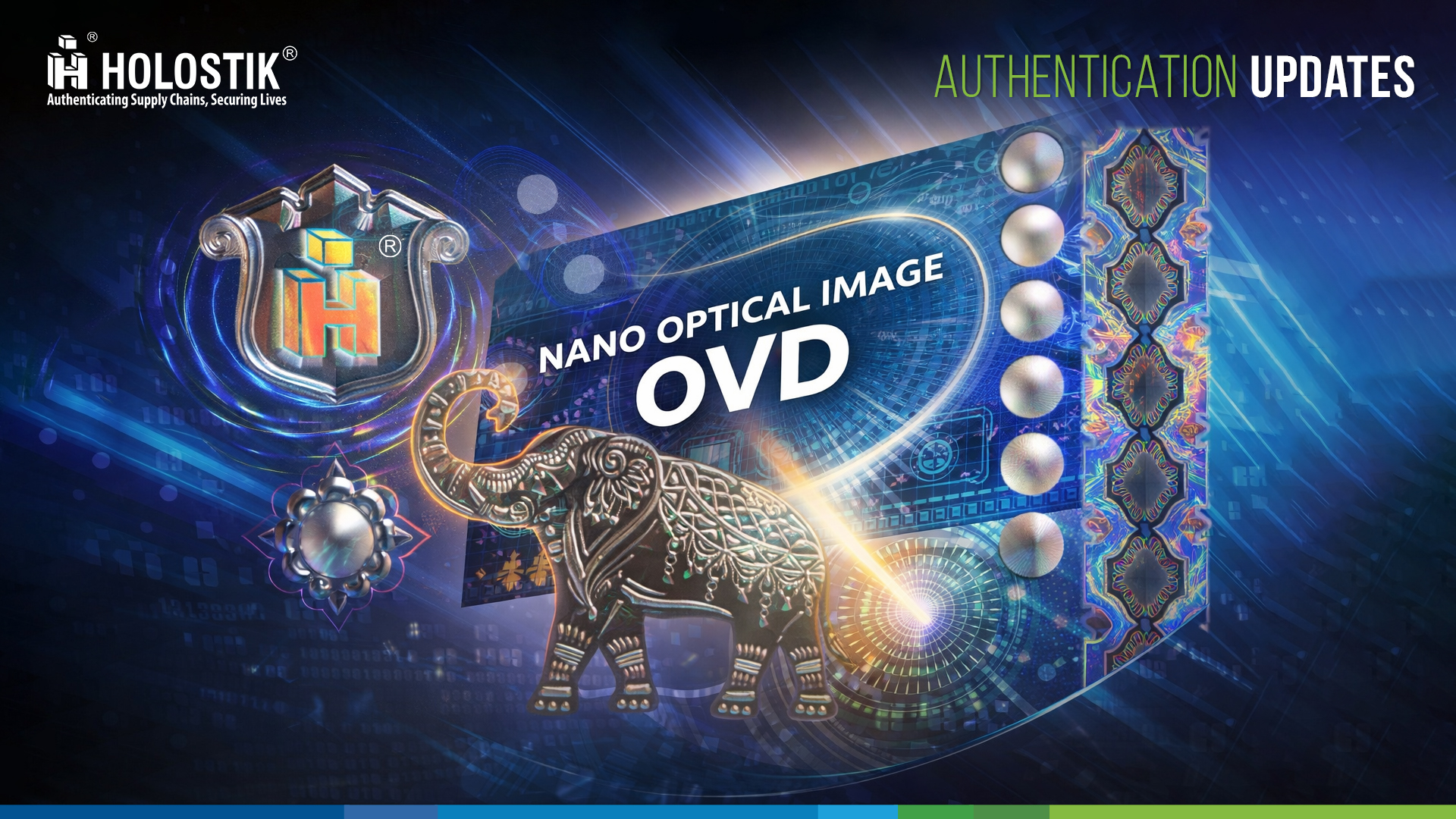
Nano Optical Image (NOI) technology represents a significant advancement in optical security.
Operating at the nanometer scale, NOI technology enables the creation of structures that interact with light in highly controlled ways, far beyond the capabilities of conventional holography.
In practical terms:
- Nano-scale features are invisible to standard scanning and reproduction systems
- Advanced lithography techniques create precise 3D microstructures that cannot be replicated using conventional methods
- These structures do not merely reflect light, they control its amplitude, phase and polarization
- This results in distinct optical effects such as dynamic motion, depth perception, and color variation
The outcome is a security feature that is not just visually distinctive, but scientifically engineered to resist duplication, even with access to advanced tools.
A Fundamental Shift: From Visual Assurance to Verifiable Security
The approach to authentication is undergoing a critical transformation.
Earlier:
“Does the product look genuine?”
Today:
“Can the product be verified as genuine?”
This shift is significant.
Visual elements can be replicated.
Engineered optical structures, however, introduce layers of complexity that are inherently difficult to duplicate.
Holostik’s Approach: 4th Generation NOI OVDs
At Holostik, we have aligned our innovation efforts with this evolving security landscape.
Our 4th Generation Nano Optical Image (NOI) OVDs are designed to address modern counterfeiting challenges through a combination of precision engineering and digital integration.
Key capabilities include:
- 600,000+ DPI mastering
Delivering the level of precision required for today’s threat environment - Nano-scale optical structures
Creating features that remain beyond the reach of conventional reproduction technologies - AI-resistant design architecture
Preventing reverse engineering through digital or image-based tools - Unique optical signatures
Enabling reliable verification through specialized systems - Phygital integration readiness
Seamlessly connecting with track & trace platforms, authentication applications, and supply chain ecosystems
This approach ensures that security is not just applied, but embedded at a scientific level.
What This Means for Brand Owners
Continuing with conventional holograms as the primary security layer presents tangible risks:
- Increasing similarity between counterfeit and genuine products
- Revenue leakage without immediate detection
- Erosion of consumer trust
- Challenges in establishing product authenticity during disputes or investigations
In contrast, adopting nano-level security enables:
- Stronger and more resilient protection against duplication
- Enhanced visibility and control across the supply chain
- Greater confidence in product authenticity
- Improved ability to verify and defend brand integrit
A Strategic Question to Consider
Instead of asking:
“Does my packaging look secure?”
It is now more relevant to ask:
“Can my product withstand verification?”
Because in today’s environment, visual appeal can be replicated.
Authenticity must be engineered.
Conclusion: Moving Beyond Perception to Protection
The era of relying solely on “shiny stickers” is gradually coming to an end.
Brands that proactively upgrade their security infrastructure will be better positioned to mitigate risks, protect revenue, and maintain consumer trust.
Because ultimately:
- Designs can be copied
- Prints can be replicated
- But nano-level precision introduces a barrier that changes the equation entirely
Let’s Connect
If you are evaluating your current authentication strategy, now is the right time to reassess its effectiveness. (Contact Us)
Is your solution adding visual appeal or delivering real security?
We would be happy to discuss how Holostik’s 4th Generation NOI OVDs can strengthen your brand protection framework and where they best fit within your operations.