


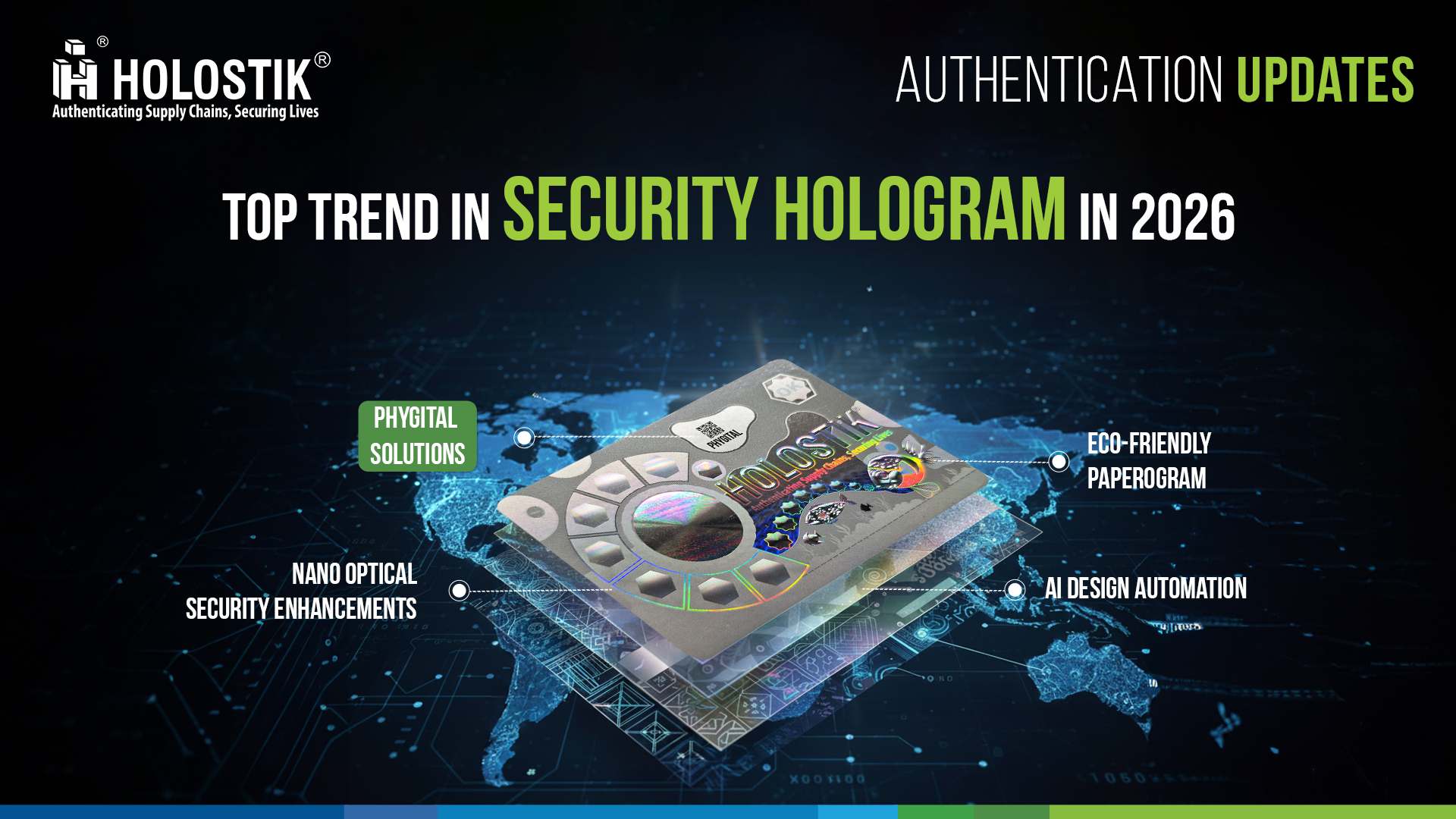
As global supply chains grow increasingly complex, the Security Hologram market trends in 2026 reflect a decisive shift toward advanced, digital-ready authentication. Holograms have evolved from simple optical deterrents into multi-layered security technologies blending nano-optics, AI, digital identities, and sustainability.
This transformation is supported by strong market growth. According to Expert Market Research, the global security hologram market, valued at USD 5.84 billion in 2024, is projected to reach USD 12.61 billion by 2034, growing at a CAGR of approximately 8%.
With the market nearly expected to double in the next decade, 2026 is a pivotal moment for innovation in the holography industry.
1. Nano-Precision Holography Becomes the Benchmark
Counterfeiters now have access to advanced digital replication tools, making traditional holograms easier to imitate. In 2026, the shift is toward nano-optical structures with ultra-fine diffraction patterns that create unique optical signatures impossible to duplicate with standard equipment.
Holostik is already implementing nano-origination and ultra-high resolution of more than 6 Lakh DPI to produce holograms with enhanced visual depth, microscopic text, and covert nano-patterns, significantly increasing security for high-risk sectors.

2. Phygital (Physical + Digital) Holograms Drive Mainstream Adoption
One of the strongest market shifts is the merging of physical holography with digital verification.
In 2026, holograms commonly carry:
-
Serialized QR, RFID or NFC links
-
Machine-readable optical features
-
API-based connections to verification systems
Brands increasingly require dual-layer security, where physical authenticity is instantly reinforced with a digital response. Holostik has contributed to this shift by integrating holograms with digital solutions (SureAssure – our SaaS based product), allowing real-time authentication, warranty validation and supply chain traceability.
3. Tamper-Evident & Intelligent Holograms Redefine Packaging Security
Packaging is no longer just a vessel; it has become a frontline defence. In 2026, holograms are designed to react intelligently when tampered with, offering not just visual indicators but behavioural signals that authenticate the product’s integrity.
Trending innovations include:
-
Holographic VOID/OPEN reveal patterns
-
Anti-transfer films that disintegrate upon removal
-
First-open indicators linked to digital logs

A notable advancement in this space is the emergence of functional holograms, these are security devices that incorporate physical properties beyond optics. One such example is Holostik’s development of a meter-seal hologram enhanced with surface conductivity, designed for a utility-sector client. In this solution, the hologram’s conductive pathway acts as an additional security layer: if the seal is broken and reattached, the conductivity changes, instantly revealing tampering during verification.
This blend of optical security and measurable physical properties reflects the evolving expectations of brand owners and regulators. It also demonstrates how tamper-evidence is moving beyond visible change toward science-backed, irreversible indicators that support litigation-grade authentication.
4. Sustainability Shapes the Next Generation of Holograms
Environmental responsibility is reshaping every layer of packaging, and holograms are no exception. As brands set ambitious sustainability goals, holographic security is evolving toward lighter, greener and more resource-efficient formats.
Key shifts in 2026 include:
-
Thinner, recyclable films
-
Solvent-free coatings
-
Energy-efficient laser origination
-
Reduced material-to-security ratios

One of the most significant developments in this space is the transition from PET-based holograms to paper-based holographic security. Holostik’s award-winning Paperogram exemplifies this shift, a hologram applied directly on paper instead of polyester film without compromising optical complexity or tamper-resistance. By replacing a PET substrate with a renewable, more easily recyclable material, Paperogram offers a sustainable alternative for industries seeking lower environmental impact while maintaining high-security standards.
Holostik’s broader R&D focus supports this trajectory by reducing material consumption, optimising energy usage and rethinking substrates, ensuring that future holograms deliver both security and sustainability, rather than forcing brands to choose between the two.
5. AI-Driven Hologram Design & Automated Verification
Artificial intelligence is becoming central to both the creation and verification of holograms.
Key advancements include:
-
AI-generated holographic patterns too complex for counterfeiters
-
Automated machine-vision authentication systems
-
Predictive analytics that detect duplication hotspots
Holostik has been experimenting with AI-supported design optimisation and compatibility with automated vision inspection systems, enabling faster and more accurate verification at scale.
6. High-Security Government-Grade Holography Accelerates Worldwide
Governments across the world are strengthening authentication frameworks to curb illicit trade, enhance excise compliance and secure citizen identity programs. As a result, 2026 sees rising demand for:
-
Multi-layer holographic tax stamps
-
Serialised, cloud-linked authentication
-
Durable holograms suitable for challenging field conditions

In this domain, institutional trust and legacy play a critical role. Holostik has a long track record of supporting government and public-sector authentication programs, working with several state governments, universities, excise departments and regulatory bodies across India. Among the earliest and most defining milestones in this journey was in 1995, when the Election Commission of India, now part of Holostik’s esteemed client legacy, approved the use of holograms on Election ID cards under the leadership of T. N. Seshan, the then Chief Election Commissioner. This decision marked a national shift toward secure identity documentation and demonstrated the transformative potential of holography in governance.
Today, Holostik continues to contribute overt, covert and forensic-grade holographic features to government-grade security programs, supporting modern requirements for reliability, scalability and tamper-resistance.
The Road Ahead: Holograms as Intelligent Trust Technologies
The Security Hologram market trends in 2026 point to a powerful transformation, from static optical devices to intelligent, data-connected trust technologies.
Holograms are becoming:
-
Proof of authenticity
-
Signals of tampering
-
Gateways to digital verification
-
Components of supply chain intelligence systems
By integrating nano-holography, phygital authentication, AI tooling and sustainable materials, Holostik is helping brands transition from detecting counterfeits to preventing them.
2026 marks the beginning of a new era where holograms serve not just as security labels, but as essential anchors of trust in global commerce.
Speak to our team to explore what’s right for your brand.
📞 +91 9905-124-124 | ✉ marcom@holostik.com | 🌐www.holostik.com