


Articles
What Is a Hologram? Types, Uses, History & Security

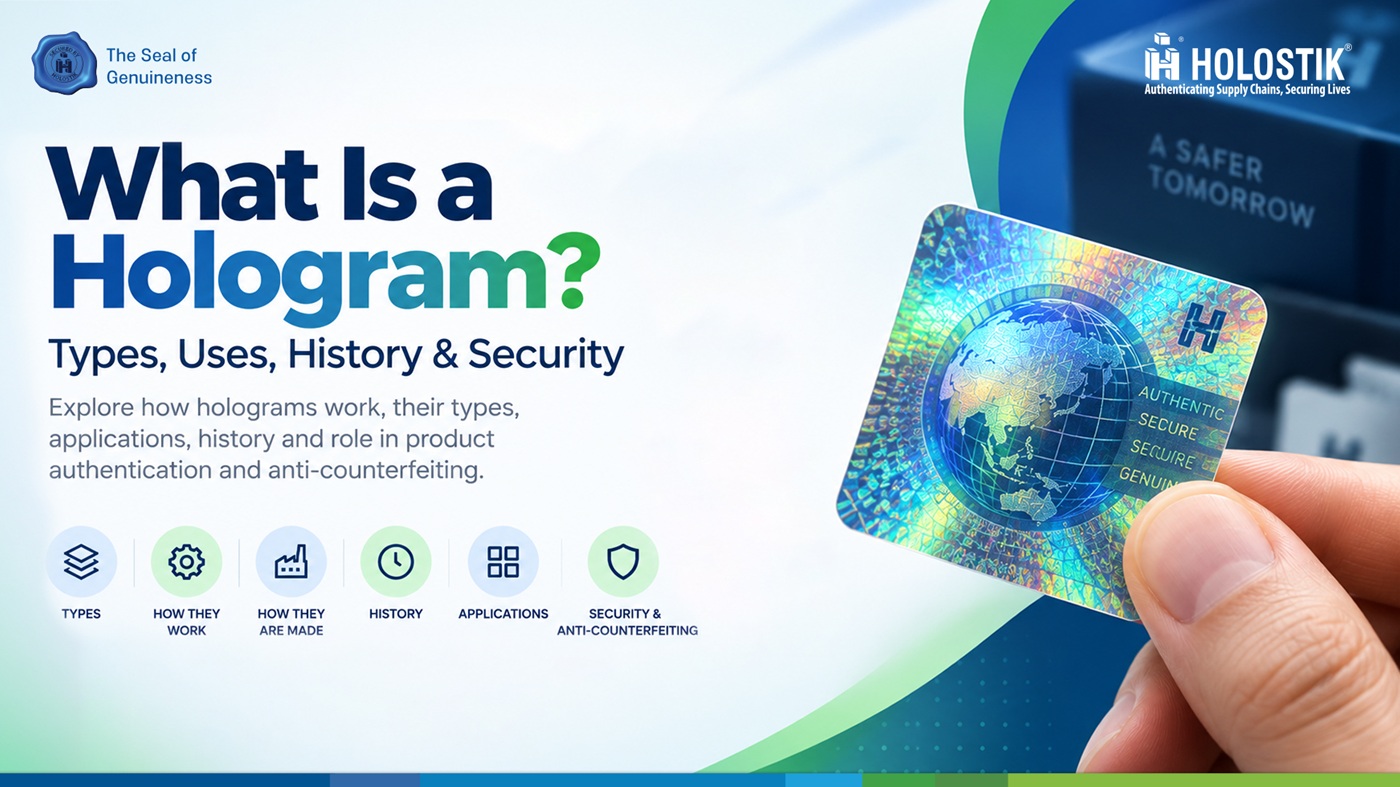
Holograms are three-dimensional visual representations created using holographic technology. Unlike a conventional printed image, a hologram can create an appearance of depth, movement, colour variation or other optical effects that change as the viewing angle changes.
Today, holograms are used across a wide range of applications, from entertainment and displays to product authentication, brand protection, packaging and anti-counterfeiting. Security holograms are particularly useful because they can combine distinctive optical effects with customised security features that make products more difficult to counterfeit.
This guide explains what a hologram is, how holograms work, how they are made, their history, types, applications and how holograms are used as security and anti-counterfeiting features.
What is a Hologram?
A hologram is a visual representation produced using holographic technology that records and reconstructs light to create the appearance of a three-dimensional image.
Unlike a standard photograph, which records the intensity and colour of light in a scene, holographic techniques can preserve information about the light wavefront. When the hologram is illuminated under suitable conditions, this information can be reconstructed to produce a visual image with depth or other optical effects.
The word hologram is commonly used to describe both holographic recordings and the resulting holographic images or optical features.
What is holography?
Holography is the technique or process used to create and reconstruct holographic images. It uses the behaviour of light to record information that can later be reconstructed as an image.
In commercial applications, the term “hologram” can also refer to security and decorative optical features manufactured using specialised holographic or nano-optical processes.
What makes a hologram different from a normal image?
A conventional printed image generally appears the same from different viewing angles. A holographic feature can produce changing visual effects depending on how it is illuminated or viewed.
These effects can include:
- Apparent three-dimensional depth
- Motion or animation-like effects
- Colour changes
- Lens effects
- Image switching
- Kinetic effects
- Fine text or micro-image elements
- Other customised optical effects
These characteristics make holographic technology useful not only for visual enhancement but also for authentication and security applications.
How Do Holograms Work?
A hologram works by using the properties of light to record and reconstruct information that produces a visual image or optical effect.
In traditional holography, a light source is divided into two paths. One illuminates the object being recorded, while the other acts as a reference beam. The interaction between these light waves creates an interference pattern that can be recorded on a suitable medium.
When the resulting hologram is illuminated appropriately, the recorded optical information interacts with light and reconstructs the wavefront associated with the original image. This creates the perception of a three-dimensional image.
How does a hologram create a 3D effect?
The three-dimensional appearance comes from the way the holographic recording contains information about the light coming from different parts of the recorded scene.
As the viewing position changes, the observer receives different portions of the reconstructed light information. This can create a perception of depth, perspective and movement.
Commercial security holograms may use engineered optical structures to create controlled effects such as motion, colour variation, lens effects and three-dimensional visualisation.
How Are Holograms Made?
The exact manufacturing process depends on the type and intended application of the hologram.
A simplified hologram manufacturing process can involve several stages:
1. Design and holographic origination
The desired visual and security features are first designed. For security applications, this can include customised logos, text, images, patterns and optical effects.
2. Master creation
The designed optical information is transferred into a master structure using a specialised holographic or optical origination process.
3. Replication
The master is used to replicate the holographic structure onto a suitable material or substrate. Commercial replication techniques allow holographic effects to be produced at scale.
4. Integration into the final product
The holographic feature can then be incorporated into products such as:
- Labels
- Stickers
- Security seals
- Packaging
- Holographic films
- Holographic foils
- Secure documents
- Product authentication features
How are security holograms made?
Security holograms are designed with authentication and anti-counterfeiting requirements in mind. In addition to the primary holographic effect, they may incorporate multiple visible and invisible security features.
Depending on the security requirement, these can include customised optical effects, microtext, micro-images, nano-scale structures, colour-shifting effects and other authentication elements.
The complexity of these features can make unauthorised reproduction significantly more difficult.
History of Holograms: Who Invented Holography?
The foundations of modern holography were developed in the twentieth century.
Dennis Gabor developed the basic concept of holography while working on electron microscopy. His work established the principles that later enabled the development of practical holographic imaging.
Gabor was awarded the Nobel Prize in Physics in 1971 for his invention and development of holographic methods.
The development of laser technology later made practical optical holography much more achievable. Since then, holographic technology has evolved considerably, moving from laboratory applications into commercial areas such as security, packaging, authentication, displays and entertainment.
Types of Holograms
Holograms can be classified in different ways depending on how they are created, their optical structure and their intended application.
Some commonly encountered types include:
2D Holograms
2D holograms primarily use flat graphical elements and optical effects to create visual changes when viewed from different angles.
2D/3D Holograms
These combine multiple image layers to create a stronger perception of depth and dimensionality.
3D Holograms
3D holographic features create the perception of depth and three-dimensional imagery through specialised optical structures.
Dot Matrix Holograms
Dot matrix techniques can generate detailed holographic patterns and optical effects by controlling microscopic structures across the holographic surface.
Nano-Optical Holograms
Nano-optical holographic technologies use extremely small optical structures to generate sophisticated visual and security effects.
These technologies can be used to create features such as microtext, micro-images, motion, lens effects, colour variation and other complex optical effects.
Security Holograms
Security holograms are holographic or hologram-like optical features specifically designed for authentication, brand protection and anti-counterfeiting.
They can be incorporated into labels, stickers, seals, packaging, documents and other products.
What Are Holograms Used For?
Holograms have applications across entertainment, education, packaging, product identification, security and authentication.
Common applications include:
- Product authentication
- Anti-counterfeiting
- Brand protection
- Security labels
- Hologram stickers
- Packaging
- Secure documents
- Identification and authentication
- Promotional and decorative packaging
- Displays and visual communication
- Education and scientific applications
- Entertainment
Among these applications, security and authentication are particularly important for products that face counterfeiting and unauthorised duplication.
How Are Holograms Used for Anti-Counterfeiting?
Holograms can be used as anti-counterfeiting features by providing distinctive optical effects and customised security elements that help consumers, retailers and authorised personnel distinguish genuine products from counterfeit ones.
A security hologram can be designed specifically for a brand, product or packaging format. Instead of relying only on a generic visual effect, multiple security features can be combined within the holographic structure.
How do holograms help prevent counterfeiting?
Holograms can contribute to anti-counterfeiting in several ways:
- Difficult-to-replicate optical structures
Advanced holographic and nano-optical structures can be difficult to reproduce accurately without specialised origination and manufacturing capabilities.
- Easy visual authentication
Overt visual effects can allow users to perform a quick first-level check by looking for expected images, movement, colour changes or other characteristics.
- Customised security features
A hologram can incorporate brand-specific elements such as logos, text, images and proprietary visual effects.
- Multiple layers of authentication
Security holograms can combine several overt and covert features within a single security element, creating multiple levels of verification.
- Integration with packaging and labels
Holographic features can be incorporated into security labels, seals, packaging films, foils and other product components.
- Combination with digital authentication
Holograms can also be combined with QR codes, serialisation and digital authentication systems to create a physical and digital approach to product verification.
Holostik’s security-hologram portfolio, for example, includes holographic solutions with visible and invisible security features, QR integration and nano-optical technologies.
What Is a Security Hologram?
A security hologram is a specialised holographic security feature designed to help authenticate products, packaging, documents or other assets and deter counterfeiting.
Unlike a purely decorative holographic effect, a security hologram is developed around an authentication requirement.
It may include:
- Customised images and logos
- 2D and 3D effects
- Motion effects
- Colour-shifting effects
- Microtext
- Micro-images
- Nano-optical structures
- Overt security features
- Covert security features
- QR codes
- Serialisation
- Other customised authentication elements
The appropriate combination depends on the product, threat level, authentication process and required security level.
What Security Features Can a Hologram Have?
The security strength of a hologram depends not simply on its appearance but on the complexity, uniqueness and combination of its security features.
Security holograms can incorporate both overt and covert authentication features.
Overt security features
These are features that can potentially be checked without specialised equipment.
Examples include:
- Visible holographic effects
- Colour changes
- Motion effects
- 3D images
- Lens effects
- Image switching
- Brand-specific visual elements
Covert security features
These are designed for verification using specialised methods, equipment or knowledge.
Examples may include:
- Microtext
- Hidden images
- Fine optical structures
- Nano-scale features
- Specialised authentication elements
Advanced holographic technologies can combine multiple layers of security within one feature. For example, Holostik’s 4th-generation NOI technology incorporates nano text, micro-image patterns, colour effects and submicron 3D structures.
Holograms for Product Authentication
Product authentication is one of the most common security applications of holographic technology.
A manufacturer can place a customised holographic feature on a product or its packaging. The expected visual characteristics can then be used as an initial indication of authenticity.
For higher-security applications, holographic authentication can be combined with additional physical or digital technologies.
For example:
Hologram + QR code + serialisation + digital verification
This approach can connect the physical security feature with a digital record, helping brands strengthen authentication and improve product traceability.
Holostik’s existing security solutions similarly combine holographic and digital layers for applications involving product security and supply-chain visibility.
What is a Hologram Sticker?
A hologram sticker is a self-adhesive label or sticker featuring a holographic image or optical security element.
Hologram stickers are commonly used for:
- Product authentication
- Anti-counterfeiting
- Brand protection
- Packaging security
- Warranty and identification applications
- Promotional and decorative purposes
A security hologram sticker can be customised with a company’s logo, text, graphics and security features.
Depending on the design, it may provide a quick visual authentication check or incorporate additional features for higher-level verification.
Hologram Sticker vs Security Hologram
The terms are sometimes used interchangeably, but they describe slightly different things.
A hologram refers to the underlying holographic/optical feature.
A hologram sticker describes a physical adhesive format in which that feature is supplied as a sticker or label.
A security hologram describes the intended security and authentication function.
Therefore, a hologram sticker can also be a security hologram when it is designed specifically for authentication and anti-counterfeiting.
Want to learn more?
Explore our detailed guide on Hologram Stickers: Types, Uses, Features & Authentication.
Looking for a solution?
Explore our Hologram Sticker / Security Hologram products for customised product authentication and brand-protection applications.
Holograms in Packaging
Holographic technology can be incorporated into packaging in several forms, including:
- Holographic films
- Holographic foils
- Hologram labels
- Hologram stickers
- Security seals
- Holographic strips
- Holographic packaging elements
Besides providing visual appeal, holographic features can add an authentication layer to packaging.
For example, a security hologram can be integrated into a product label or packaging seal so that the authentication feature becomes part of the original pack.
This can be particularly useful for industries where counterfeit products can create financial, safety or reputational risks.
Holograms in Anti-Counterfeiting and Brand Protection
Counterfeit products can affect manufacturers in several ways, including lost revenue, damage to brand reputation, customer distrust and potential safety concerns.
Holograms are one of the physical security technologies that brands can use as part of a broader anti-counterfeiting strategy.
A robust brand-protection programme may combine:
- Security holograms
- Tamper-evident labels
- Secure packaging
- QR-based authentication
- Serialisation
- Track and trace
- Digital verification
- Other physical and digital security technologies
The most appropriate solution depends on the product and the counterfeiting risk.
For high-security requirements, holographic technologies can be engineered with multiple security layers rather than relying on a single visible holographic effect.
Hologram vs QR Code
No. A hologram and a QR code serve different functions, although they can be combined.
A QR code is primarily a machine-readable digital access mechanism. It can connect a consumer or supply-chain participant to information or an authentication platform.
A hologram is a physical optical security feature that can provide visual authentication and incorporate specialised security structures.
Using both can create a physical + digital authentication system.
For example:
Hologram → visual authentication
QR code → digital verification
Serial number → individual product identification
Together, these technologies can provide a more comprehensive approach than relying on any single feature.
Hologram Applications Across Industries
Security holograms can be adapted to different product formats and authentication requirements.
Pharmaceuticals
Holographic security features can be incorporated into pharmaceutical labels, cartons, seals and packaging to support product authentication and brand protection.
FMCG
Consumer products can use holographic labels, stickers and packaging features to help distinguish genuine products from counterfeits.
Automotive
Holograms can be used on automotive components, aftermarket products, labels and packaging to support authentication.
Electronics
Security holograms can help brands authenticate electronics, accessories, components and their packaging.
Apparel and Fashion
Holographic features can be integrated into garment tags, labels and packaging to support brand authentication.
Building Materials
Security holograms can be used on products and packaging where counterfeit building materials can affect brand reputation and customer confidence.
Nutraceuticals
Holograms can be integrated into bottles, cartons, labels and other packaging formats for product authentication.
Tobacco and Other Regulated Products
Holographic security features can be integrated into packaging, seals and other authentication formats.
Holostik’s existing applications span pharmaceuticals, FMCG, automotive, electronics, apparel, nutraceuticals, building materials and other industries.
Are Holograms Impossible to Copy?
No security technology should be described as completely impossible to copy.
The purpose of an advanced security hologram is to increase the difficulty, cost and expertise required to reproduce a convincing counterfeit and to provide authentication features that are difficult to replicate accurately.
Security can be strengthened by combining multiple features, customised origination, covert elements and digital authentication.
For this reason, brands should evaluate holograms as part of a broader anti-counterfeiting and authentication strategy rather than treating a hologram as a standalone guarantee of authenticity.
How Can You Check a Security Hologram?
The authentication method depends on how the hologram has been designed.
For a basic overt feature, users may check:
- Whether the expected holographic image is present.
- Whether the image changes correctly when tilted.
- Whether expected colour, motion or 3D effects appear.
- Whether the logo, text or other customised elements match.
- Whether the security feature appears intact.
For advanced security holograms, additional authentication may require specialised knowledge, equipment or digital verification.
If a hologram incorporates a QR code or serial number, the brand’s designated authentication system may provide an additional verification layer.
Why Are Holograms Used for Security?
Holograms are used for security because they can combine visual recognisability, customisation and complex optical structures in a compact physical feature.
Key advantages can include:
- Quick visual authentication
- Customisable designs
- Multiple security layers
- Difficult-to-replicate optical structures
- Integration with labels and packaging
- Compatibility with digital authentication
- Brand-specific authentication features
- Strong visual differentiation
The security value of a hologram ultimately depends on its design, origination, manufacturing quality, security features and how it is incorporated into the brand’s overall authentication system.
The Future of Hologram Security
Holographic security is evolving from simple visual effects towards increasingly sophisticated multi-layer and phygital authentication systems.
Modern security solutions can combine:
Physical security + optical authentication + digital verification + traceability
For example, an advanced product-security label could combine a holographic feature with a QR code, serialisation and a digital authentication platform.
This approach allows the hologram to serve as the physical authentication layer while digital technologies provide additional verification and supply-chain information.
The result is a shift from a simple “security sticker” towards a more connected product-security ecosystem.
Frequently Asked Questions About Holograms
What is a hologram in simple words?
A hologram is an optical representation that uses holographic technology to create the appearance of a three-dimensional image or other changing visual effects.
How does a hologram work?
A hologram works by recording and reconstructing information carried by light. Depending on the technology, this can produce depth, motion, colour variation and other optical effects.
Who invented the hologram?
Dennis Gabor developed the fundamental concept of holography and was awarded the 1971 Nobel Prize in Physics for his invention and development of holographic methods.
What are holograms used for?
Holograms are used for security, product authentication, anti-counterfeiting, packaging, labels, secure documents, displays, education and entertainment.
What is a security hologram?
A security hologram is a holographic or optical security feature designed to support product authentication, brand protection and counterfeit deterrence.
How do holograms prevent counterfeiting?
Holograms can make counterfeiting more difficult by incorporating customised and complex optical structures and multiple overt or covert authentication features.
Can holograms be copied?
Holograms can be imitated or counterfeited, but advanced security holograms can be designed with complex, customised and difficult-to-reproduce features that increase the difficulty of producing convincing copies.
What is a hologram sticker?
A hologram sticker is an adhesive label containing a holographic feature. When designed for security, it can be used for product authentication and anti-counterfeiting.
What is the difference between a hologram and a holographic image?
A holographic image is the visual result produced through holographic techniques, while “hologram” is commonly used to describe the holographic recording or optical feature itself.
Can a hologram contain a QR code?
Yes. Holographic security features can be combined with QR codes to provide both physical visual authentication and digital verification.
Are holograms used for pharmaceutical authentication?
Yes. Holographic security features can be incorporated into pharmaceutical labels, cartons, seals and packaging to support product authentication and brand protection.
Conclusion
Holograms have evolved from a scientific imaging technology into a versatile technology used across authentication, anti-counterfeiting, packaging, brand protection and visual communication.
For security applications, the value of a hologram lies not simply in its visual appearance but in the ability to combine customised optical effects, overt and covert security features and, increasingly, digital authentication technologies.
As counterfeiting becomes more sophisticated, holographic security can form one layer of a broader physical and digital product-protection strategy.
For businesses evaluating holograms for authentication or anti-counterfeiting, the right solution depends on the product, packaging format, counterfeiting risk, authentication process and required level of security.