


Articles
Counterfeiting as a Hidden Business Risk for Indian Brands


Counterfeiting is often seen as a legal or brand issue rather than a business risk. As a result, many companies only address it after the damage has already been done. However, recent findings from the State of Counterfeiting in India 2025 (ASPA–CRISIL) reveal the scale of the challenge. Nearly 89% of urban consumers have purchased a counterfeit product at least once, while 74% believe counterfeiting has increased in their region over the past year. Globally, counterfeit trade is estimated by the OECD to be worth USD 467 billion, making it one of the world’s largest illicit industries.
For Indian brands expanding across domestic and international markets, counterfeiting is no longer just an intellectual property concern. It impacts revenue, weakens consumer trust, disrupts supply chains and exposes businesses to regulatory and reputational risks. In this edition of India Business & Trade, in collaboration with Holostik, we explore why counterfeiting deserves the same strategic attention as other critical business risks and how businesses can build stronger protection against it.
Ankit Gupta, President of the Authentication Solution Providers’ Association (ASPA) and Joint Managing Director at Holostik, explains that counterfeiting is no longer confined to fake products alone. The growing complexity of fragmented supply chains, coupled with the easy availability of look-alike products across physical and digital marketplaces, has made brand protection a strategic business priority. He adds that businesses must move beyond reactive enforcement and adopt proactive authentication and traceability strategies that empower both supply chain partners and consumers.
Why Counterfeiting is a Business Risk, Not Just a Legal Problem
Counterfeiting affects businesses in ways that often remain invisible until the impact becomes significant.
Revenue Leakage
Every counterfeit product sold represents a lost opportunity for the genuine manufacturer. Every counterfeit sale reduces legitimate revenue, weakens market share and impacts overall profitability.
Consumer Safety and Liability
In industries such as pharmaceuticals, agrochemicals, automotive components, and electronics, counterfeit products can result in serious safety incidents. Although the counterfeit product is at fault, consumers often associate the negative experience with the original brand.
Brand Equity Erosion
Trust takes years to build but only a single counterfeit experience to weaken. When customers unknowingly purchase fake products, dissatisfaction is directed toward the genuine manufacturer, affecting long-term loyalty and brand reputation.
Where Counterfeiting Hides in Plain Sight
Counterfeiting rarely exists only in illegal manufacturing units. Today, it appears through multiple channels across the supply chain.
Grey Market Diversion
Products diverted through unauthorized distributors often enter markets outside approved channels. They may be repackaged or relabelled, making them difficult to distinguish from legitimate inventory without proper verification systems.
Look-Alike Packaging
Modern counterfeiters have become highly sophisticated in replicating packaging designs, colours and branding elements. To the average consumer, counterfeit products often appear identical to genuine ones.
Refilled or Recycled Packaging
Original containers collected from consumers or retailers are refilled with substandard products and reintroduced into the market. This practice is particularly common in lubricants, pesticides, chemicals and liquor.
Digital and E-commerce Counterfeits
The growth of online marketplaces has created new opportunities for counterfeiters. Fake listings frequently use genuine product images and descriptions, making authenticity difficult for customers to verify before purchase.
Cross-Border Leakage
Counterfeit products entering export markets under a genuine brand’s identity can damage a company’s reputation even in regions where it has only recently established its presence.
The Cost of Doing Nothing
Ignoring counterfeiting can have consequences that extend far beyond lost sales.
Businesses may experience declining customer confidence, increased warranty and complaint costs, regulatory scrutiny and damage to long-established brand reputation. Exporters also face additional challenges, as counterfeiting incidents can lead to increased inspections, delayed shipments and greater compliance requirements in international markets.
The financial impact is measurable, but the consequences often extend much further. Businesses may also face regulatory actions, legal disputes, financial penalties, increased compliance costs and long-term reputational damage. However, the loss of customer trust remains one of the most difficult and expensive challenges to rebuild.
Common Pitfalls for Indian Brands
Many organisations unintentionally leave themselves vulnerable by:
- Depending solely on packaging aesthetics instead of incorporating verifiable authentication features.
- Treating anti-counterfeiting as a one-time packaging upgrade rather than an ongoing business strategy.
- Not empowering consumers with simple, reliable tools to authenticate products before purchase.
- Maintaining limited visibility across the supply chain, making diversion difficult to detect.
- Underestimating risks posed by grey markets, refilling operations and online counterfeit sales.
Best Practices for Building Counterfeit Resilience
Layer High-Security Anti-Counterfeiting Features
Combine multiple layers of visible, covert, forensic and digital authentication technologies to create a robust anti-counterfeiting framework. Rather than relying on a single technology, businesses should adopt a layered approach that balances security, usability and cost depending on the product and market.
Enable Instant Verification for Consumer Empowerment
Provide customers with simple and intuitive ways to verify product authenticity at the point of purchase. QR code-based authentication, combined with consumer awareness initiatives and incentive programmes, can significantly improve engagement and authentication rates. Mr. Gupta emphasizes that empowering consumers transforms them into active participants in the fight against counterfeiting.
Strengthen Traceability
Implement track-and-trace systems that enable products to be monitored throughout the supply chain, helping identify diversion and unauthorized movement.
A phygital (physical + digital) approach combines secure physical identifiers such as holograms or security labels with digital technologies like unique QR codes, serialization and cloud-based authentication platforms. This enables every product to carry a unique digital identity that consumers, distributors and brand owners can instantly verify while providing end-to-end supply chain visibility and real-time traceability.
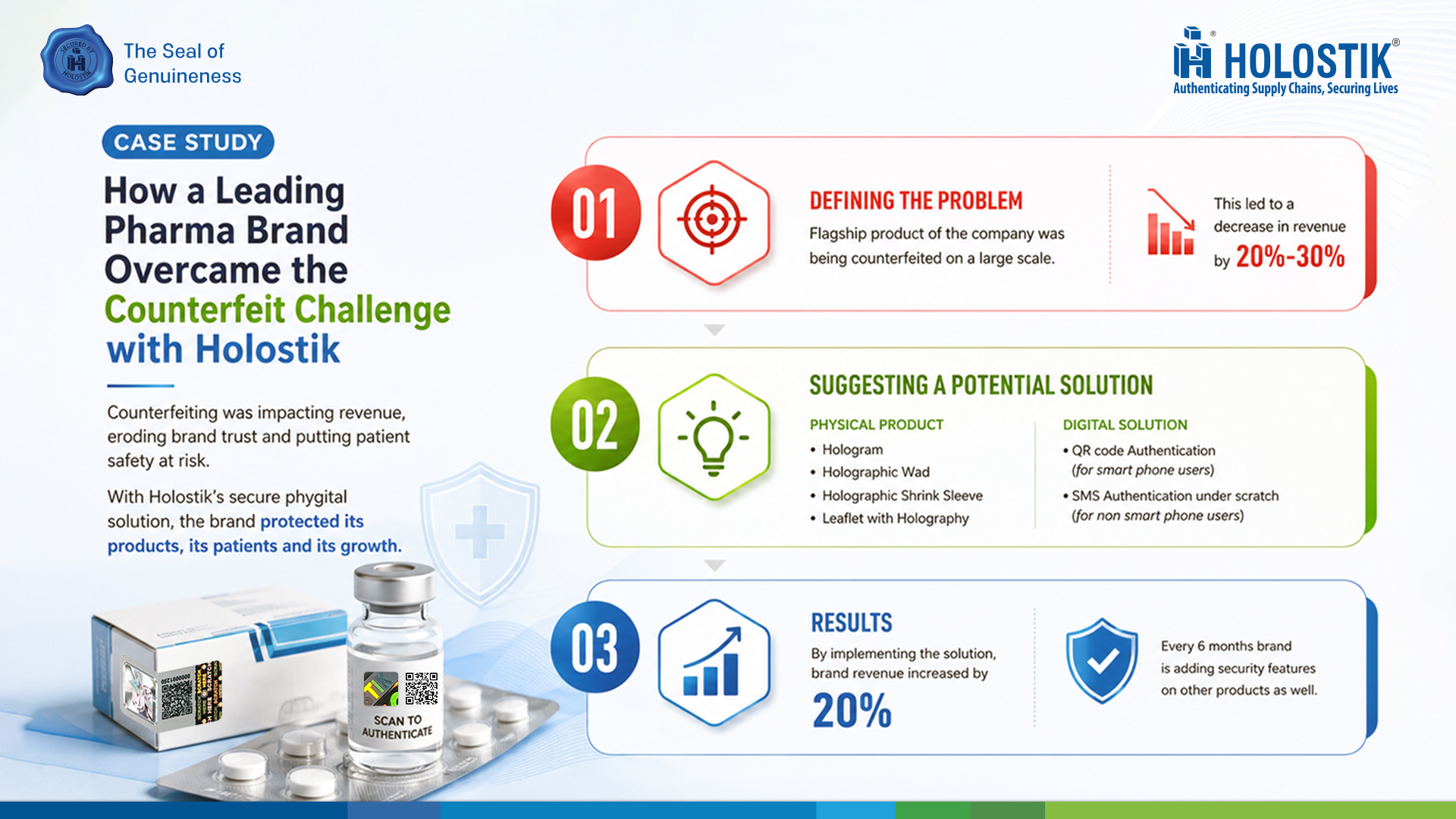
Integrate Security into Packaging Design
Authentication should be incorporated into packaging from the design stage rather than added as a reactive measure.
Adopt Security as a Strategic Investment
Anti-counterfeiting solutions should not be evaluated solely on procurement cost. Security is a long-term business investment that protects revenue, strengthens consumer confidence and safeguards brand equity. As Ankit Gupta advises, organisations should avoid treating anti-counterfeiting as an “L1 procurement strategy” focused only on the lowest cost. Instead, they should adopt the right combination of security technologies based on product risk, market conditions and business objectives.
Continuously Evolve Security Strategies
Counterfeiters continually adapt their methods. Brand protection strategies should therefore be reviewed and upgraded regularly to stay ahead of evolving threats.
Conclusion
Counterfeiting is no longer a hidden operational issue; it has become a strategic business risk. The State of Counterfeiting in India 2025 highlights both the growing scale of the problem and changing consumer expectations. With 89% of consumers having encountered counterfeit products and many expressing a willingness to pay a premium for products they can confidently verify as genuine, authenticity has become a tangible business advantage rather than simply a compliance requirement.
Mr. Gupta believes combating counterfeiting is not the responsibility of a single stakeholder. It requires collaboration between brand owners, technology providers, regulators, channel partners and consumers. Genuine products must not only be readily available but also easily verifiable, enabling every stakeholder to play an active role in protecting brands and consumers alike.
For Indian brands competing in increasingly complex domestic and global markets, protecting products means protecting revenue, reputation, customer trust and long-term business growth. Investing in robust authentication, traceability and brand protection solutions is no longer a defensive measure—it is a strategic investment in sustainable competitiveness.
Source: State of Counterfeiting in India 2025 (ASPA–CRISIL); OECD, Trade in Counterfeit and Pirated Goods.
For more information on building an effective brand protection strategy, write to us at marcom@holostik.com