


Articles
Benefits of Warehouse Management System from Holostik

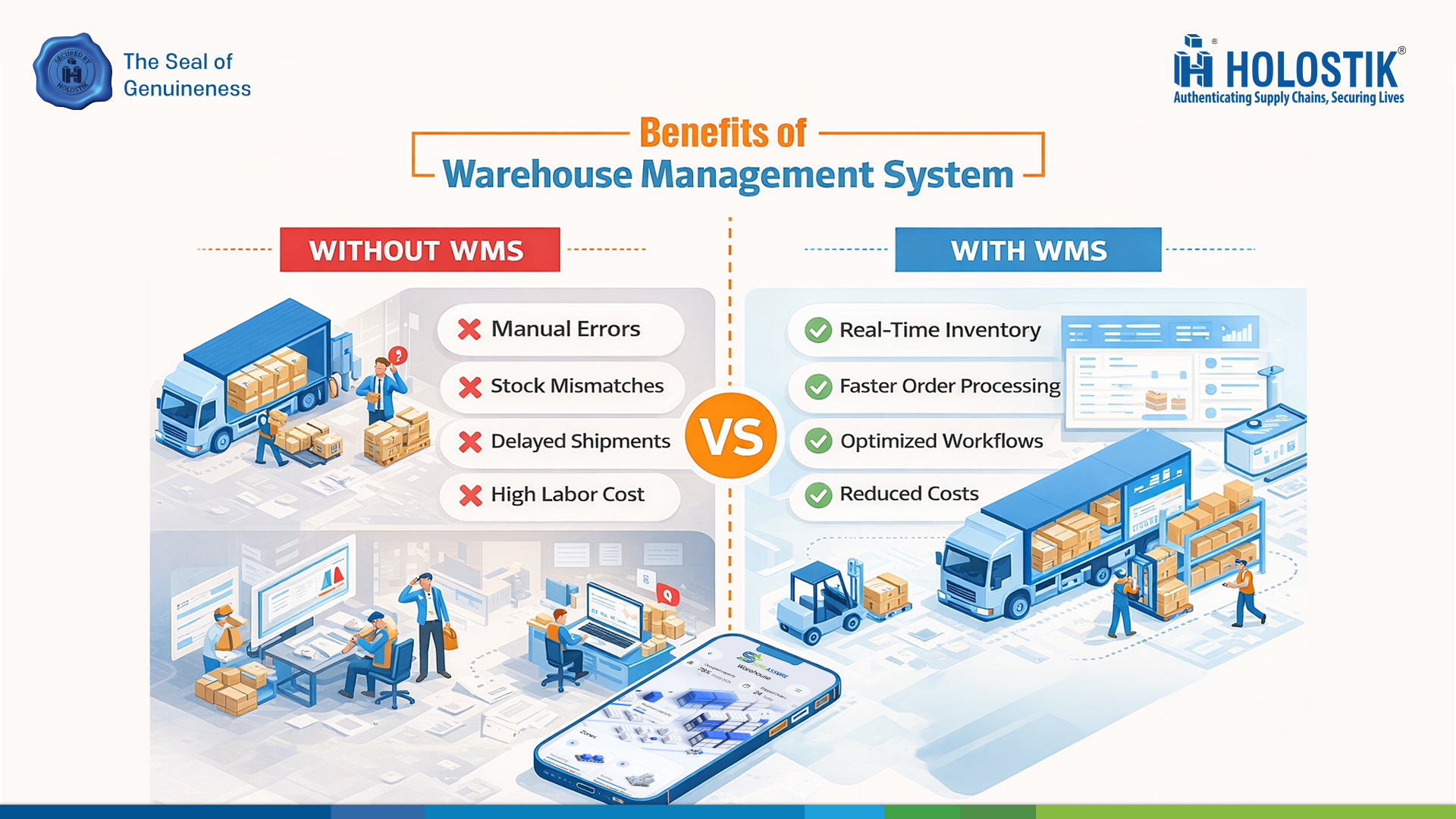
If you are a brand owner in India today, you are fighting on two fronts simultaneously — building a strong brand while protecting it from counterfeiters, grey market operators, and supply chain inefficiencies. A Warehouse Management System (WMS), especially one integrated with physical anti-counterfeiting tools like QR codes, security holograms, and tamper-evident packaging, is no longer a luxury. It is the foundation of a future-ready brand.
In this article, we break down the key benefits of a warehouse management system, explain why it matters for brand protection, and show you how Holostik’s end-to-end digital and physical solutions help brand owners take full control of their supply chain.
What Is a Warehouse Management System?
A Warehouse Management System (WMS) is a software platform that manages and optimises the operations of a warehouse or distribution centre. It tracks inventory in real time, manages the movement of goods, automates order fulfilment processes, and generates data that helps businesses make smarter decisions.
But in the context of brand-sensitive industries — pharmaceuticals, FMCG, spirits and beverages, agrochemicals, personal care, and luxury goods — a WMS does something much more important. When integrated with serialisation, QR code authentication, and security label technology, it becomes the digital backbone of an end-to-end brand protection system.
Did You Know? According to FICCI-CASCADE, counterfeit goods cause Indian industries losses worth over ₹2.7 lakh crore every year. A WMS with integrated serialisation and authentication is your first and strongest line of defence against this.
The difference between a brand that grows sustainably and one that loses revenue to fakes, parallel imports, and supply chain leakages often comes down to one thing: visibility. A WMS gives you that visibility — across every warehouse, every batch, every unit, every mile.
Top Benefits of a Warehouse Management System for Brand Owners
Let us walk through the most impactful benefits that a modern WMS delivers — not just for warehouse managers, but for brand owners, compliance teams, and supply chain leaders.
1. Real-Time Inventory Visibility Across Multiple Locations
One of the most immediate and measurable benefits of a warehouse management system is the ability to see exactly what you have, where it is, and in what condition — in real time. Whether you operate one warehouse or fifty distribution points across India, a WMS gives you a single unified view.
This eliminates ghost inventory (stock that appears in records but physically does not exist), prevents overstocking that ties up working capital, and ensures you never face an unexpected stockout during peak demand. Research consistently shows that businesses implementing WMS solutions improve inventory accuracy by an average of 27%.
2. Improved Order Accuracy and Faster Fulfilment
Manual picking and packing processes are inherently error-prone. A warehouse management system introduces structured workflows — guided picking, barcode or QR scan verification at each step, and automated packing confirmation — that dramatically reduce human error.
The result? Fewer wrong shipments, fewer returns, and faster fulfilment cycles. Businesses using WMS report up to 30% fewer fulfilment errors, which translates directly into higher customer satisfaction, fewer complaints, and stronger retailer relationships.
3. Product Traceability and Batch-Level Serialisation
This is where a WMS becomes critical for brand-sensitive industries. With a WMS, every product unit or batch can be assigned a unique identifier from the moment it is manufactured. That identifier travels with the product through every stage — storage, dispatch, distribution, and retail.
This level of traceability is essential for regulatory compliance in pharma (Schedule M, NPPA track-and-trace mandates), food safety (FSSAI requirements), and excise (e-way bill and RFID for alcohol). It also makes product recalls dramatically faster and more precise — instead of recalling an entire product line, you can isolate a specific batch and minimise consumer risk and financial damage.
4. Anti-Counterfeiting and Supply Chain Security
A WMS that is integrated with serialised security labels and QR codes creates a digital fingerprint for every product in your supply chain. Any unit that appears outside its expected distribution geography, gets scanned more than once (a common indicator of label cloning), or shows movement inconsistent with its batch record, gets flagged automatically.
This proactive detection capability is the difference between finding out your product has been counterfeited after the damage is done versus intercepting the problem at the source. For brand owners in categories like agrochemicals, OTC healthcare, and premium FMCG, this is invaluable.
5. Regulatory Compliance and Audit Readiness
Compliance requirements for Indian brand owners are growing rapidly. GST e-invoicing, FSSAI labelling and track-and-trace norms, pharma serialisation mandates, and state-wise excise compliance all demand accurate, time-stamped records of stock movement.
A WMS automates the creation of these records. Audit trails are generated automatically at every movement event. When an inspector asks for documentation, you are not scrambling through spreadsheets — you are pulling a verified digital report in seconds. This saves time, avoids penalties, and builds institutional credibility.
6. Smarter Demand Forecasting and Procurement
Modern WMS platforms do not just record what has happened — they analyse patterns and help predict what will happen next. By integrating historical sales data, seasonal trends, and distribution velocity, a WMS enables smarter procurement planning.
This means you order the right quantities at the right time, reduce end-of-season write-offs, and avoid the margin-damaging cycle of emergency procurement. For brand owners managing dozens of SKUs across regional markets, this alone can justify the entire cost of WMS implementation.
7. Reduced Operational Costs
Warehouse operations are expensive — labour, space, utilities, damage, and handling costs add up fast. A WMS optimises space utilisation through intelligent slotting, reduces unnecessary labour movement through directed workflows, and minimises product damage through better handling protocols.
Most businesses that implement a WMS see a return on investment within the first year of operation, driven by these combined efficiencies.
Key Insight: Supply chain transparency is no longer just an operational nice-to-have. It is a brand promise. Consumers and trade partners today want to know that the product they are buying is genuine, safe, and ethically distributed. A WMS makes that promise verifiable.
WMS + QR Codes, Holograms, and Security Labels: The Integration That Changes Everything
Here is where the conversation shifts from warehouse efficiency to true brand protection. A standalone WMS manages your inventory. A WMS integrated with physical security features on the product itself creates an end-to-end authentication ecosystem that neither counterfeiters nor grey market operators can easily penetrate.
This is the philosophy behind Holostik’s approach — combining world-class physical security products with a digital supply chain intelligence platform.
How the Integration Works
The process begins at the manufacturing stage. Each product unit is assigned a unique serial number in the WMS. That serial number is encoded into a QR code, embedded in a holographic security label, or printed as a unique identifier on tamper-evident packaging. From that moment, the physical product and its digital identity are inseparably linked.
As the product moves through the supply chain — from the warehouse to a regional distributor, from the distributor to a retailer, from the retailer shelf to the consumer’s hands — every handoff is logged in the WMS via a scan. The product’s journey is recorded, verified, and visible in real time.
When a consumer or trade partner scans the QR code on the product, the WMS instantly confirms authenticity, displays the product’s verified journey, and can even deliver a branded consumer engagement experience — a warranty registration, a loyalty reward, or a safety data sheet.
QR Code Authentication on Security Labels
A QR code on a Holostik security label is not a simple URL. It is a cryptographically unique, one-time-activated digital certificate. Each code is generated in the WMS, tied to a specific batch and unit, and activated upon first scan. Any subsequent attempt to scan a cloned or replicated label returns an ‘already verified’ flag — alerting the brand owner and the consumer simultaneously.
This mechanism makes product authentication accessible to everyone in the supply chain, from a retailer checking incoming stock on their smartphone to a field sales officer doing a spot audit at a shop counter.
Holographic Security Labels with Embedded Serialisation
Holostik’s holographic security labels combine multiple layers of security in a single label. Overt features — visible rainbow effects, 3D imagery, colour-shifting elements — allow anyone to perform a quick visual check. Covert features — microscopic text, UV-reactive inks, laser-readable patterns — are detectable only by trained inspectors or specialised equipment.
When these holographic labels are serialised and connected to WMS data, each individual label becomes a unique, trackable asset. If a label appears in a geography where it was never dispatched, or if the same label number is reported from two different locations simultaneously, the WMS flags it as a potential counterfeit event, triggering an investigation workflow automatically.
Tamper-Evident Packaging and Security Printed Cartons
For categories where the packaging itself is the first authentication touchpoint — premium spirits, nutraceuticals, OTC medicines, agro inputs — Holostik’s tamper-evident packaging and security printed cartons extend brand protection beyond the label.
QR codes embedded in secondary or tertiary packaging enable verification at the carton and pallet level, not just the unit level. This is especially powerful for detecting grey market diversion, where genuine products are diverted from one market to another at the bulk distribution stage.
The Holostik Advantage: When WMS data is linked to a physical QR code on a Holostik security label or hologram, you do not just know where your product is. You know whether it is genuine, how many times it has been scanned, who is scanning it, and whether its movement matches the authorised distribution plan — all in real time.
How Holostik Delivers End-to-End Brand Protection
Holostik is India’s leading manufacturer and digital solutions provider for brand protection, anti-counterfeiting, and supply chain authentication technologies. With over three decades of experience serving some of India’s most trusted brands across FMCG, pharmaceuticals, spirits, agrochemicals, and luxury goods, Holostik occupies a unique position in the market.
Unlike technology companies that build software and bolt on security features, or label manufacturers that focus purely on physical security, Holostik integrates both. Our platform connects the physical world of secure labels, holograms, and tamper-evident packaging with the digital world of WMS, serialisation, track-and-trace, and consumer authentication — in a single, cohesive solution.
Our Integrated Brand Protection Portfolio
Holostik’s end-to-end offering spans every touchpoint in the brand protection journey:
- Holographic Security Labels — overt, covert, and forensic-level authentication features
- QR Code Authentication System — unique, serialised, one-time-activation consumer and trade verification
- Consumer Engagement via QR — warranty, loyalty, and authentication in a single scan
- Tamper-Evident Packaging — carton and pouch solutions with integrated security printing
- Security Printed Cartons and Labels — customised overt and covert security printing
- Warehouse Management System — real-time inventory control, batch tracking, and dispatch management
- Track and Trace Platform — end-to-end supply chain visibility from production to point of sale
- Supply Chain Serialisation — product-level unique identification from manufacturing onward
- Regulatory Compliance Solutions — GST, FSSAI, excise, and pharma serialisation readiness
- Anti-Counterfeiting Consulting — brand risk assessment and protection strategy
What makes Holostik’s WMS distinctive is that it is purpose-built for brand protection, not just operational efficiency. It speaks the same language as our physical security products. Every label printed, every hologram applied, every QR code generated is automatically registered in the WMS — creating a seamless, closed-loop system with no gaps for counterfeiters to exploit.
Why 2026 Is the Right Time to Implement a WMS
The conditions have never been more favourable — or the stakes more high — for brand owners to adopt an integrated warehouse management and brand protection strategy.
On the regulatory front, the Indian government is tightening supply chain compliance requirements across multiple sectors. GST e-invoicing mandates, FSSAI track-and-trace rules for food and beverage, the National Pharmaceutical Pricing Authority’s push for medicine serialisation, and state excise departments’ adoption of RFID and QR-based tracking are all creating a compliance landscape where digital supply chain records are no longer optional.
On the consumer front, smartphone penetration has made product authentication accessible to anyone, anywhere. A consumer in a Tier 3 city can now scan a QR code on their agrochemical bottle and instantly verify its authenticity. This capability, once the domain of enterprise brands with deep tech budgets, is now table stakes for any brand that takes consumer trust seriously.
On the competitive front, brands that build integrated WMS and authentication infrastructure today gain a compounding advantage over time. Every serialised product is a data point. Every authenticated scan is a trust signal. Every detected counterfeit is a problem prevented before it becomes a crisis. These advantages grow stronger with every passing quarter.
The question is not whether your brand needs a Warehouse Management System integrated with QR code authentication, holographic security labels, and supply chain track-and-trace. The question is how much revenue, reputation, and market share you can afford to lose by waiting.
Conclusion
A Warehouse Management System is the operational heart of a modern, protected supply chain. When it works in isolation, it delivers efficiency gains. When it is integrated with Holostik’s physical brand protection technologies — serialised QR codes, holographic security labels, tamper-evident packaging, and security printing — it becomes something far more powerful: an end-to-end brand protection platform that gives you real-time control, consumer trust, and regulatory confidence simultaneously.
For brand owners in India who are serious about growth, compliance, and protecting what they have built, the time to act is now.