


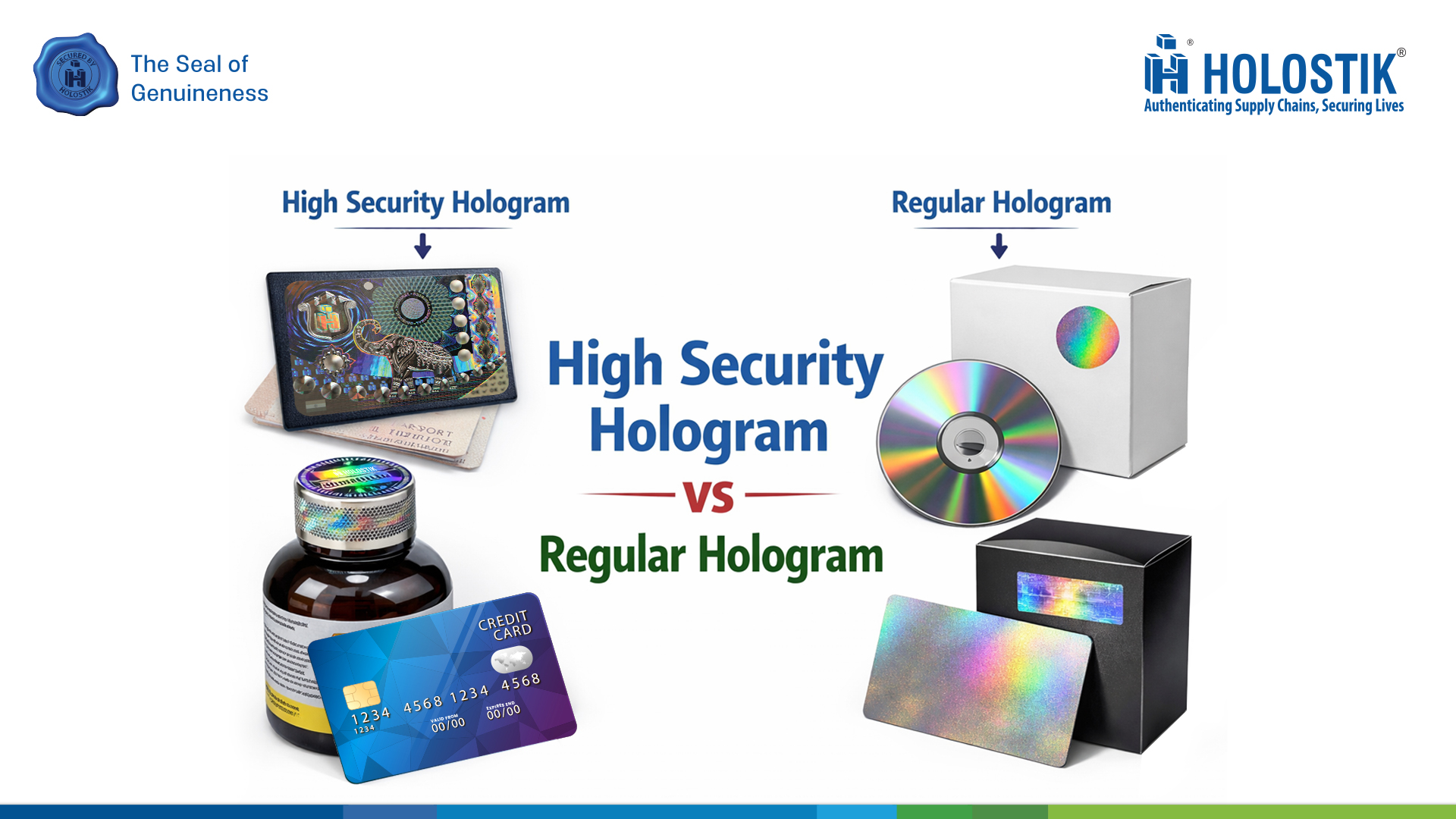
Counterfeiting is evolving and so are holograms. Both regular holograms and high security holograms look shiny and impressive on packaging, but they serve very different purposes. If you’re a brand owner, government body, or supply-chain manager deciding which to use, this guide breaks down the differences clearly and shows how Holostik’s end-to-end phygital solutions close the gap between physical security and digital traceability.
- Regular holograms mainly serve as visual deterrents and brand embellishments.
- High security holograms powered by 4th Gen Nano Optical Imaging combine advanced optical features (overt + covert + forensic) with tamper resistance and — when integrated with digital systems — traceability and authentication at scale.
Holostik provides high-quality visible holograms yet highly secured holograms plus digital tools so brands get both visual protection and actionable anti-counterfeiting intelligence.
High Security Hologram vs Regular Hologram
| Feature / Aspect | Regular Hologram | High Security Hologram |
| Primary purpose | Brand appeal, basic tamper evidence | Anti-counterfeiting, legal evidence, and authentication |
| Typical visual complexity | Standard rainbow/3D effects | Multi-layer optics, microtext, nano-optical elements |
| Overt features (visible) | Yes — decorative effects | Yes — specialized overt cues for quick checks |
| Covert features (hidden to public) | Rare or simple (e.g., invisible ink) | Common — UV inks, microtext, micro-images, hidden markers |
| Forensic features (lab verification) | Rare | Yes — embedded forensic tags or chemical markers |
| Anti-copy resistance | Low — easy to photograph & replicate | High — designed to resist high-resolution copying & printing |
| Tamper-evidence | Limited | Built-in tamper or tamper-evident options (sleeves, destructible labels) |
| Integration with digital / traceability | Uncommon | Common — serialized, track & trace capable |
| Typical industries | Retail packaging, promotional items | Pharma, government, liquor, auto parts, FMCG, electronics |
| Lifespan/durability | Moderate | High — engineered for environmental stress |
| Cost | Lower | Higher (security premium) |
| Ease of verification | Visual only | Multi-tier verification (visual → smartphone → forensic) |
| Regulatory/ legal weight | Minimal | Higher — can be used as evidence in anti-fraud cases |
| Best use cases | Brand decor, basic anti-tamper | Critical authentication, supply-chain security, and warranty management |
How High Security Holograms are Technically Different from Regular Holograms
1. Optical complexity & micro-features
- Regular: Uses standard diffraction gratings and multi-color illusions to create appealing 3D effects. Great for brand recognition but straightforward to photograph or reproduce with commodity printers.
- High security: Employs advanced micro-optics — microtext readable only with magnification, kinegrams, DOT matrix elements, micro-lettering, and nano-optics that change with angle or lighting. These features are hard or impossible to reproduce with consumer scanners/ printers.
2. Multi-layered security: overt → covert → forensic
- Overt (anyone can check) — visible holographic cues and tamper evidence.
- Covert (trained checks or simple tools) — UV markers, polarizing effects, or optically variable devices detectable with simple tools or smartphone attachments.
- Forensic (laboratory) — chemical tags, isotopic markers, or micro-particles used to prove authenticity in legal investigations.
Regular holograms usually stop at overt; high security holograms build all three layers.
3. Anti-copy & replication resistance
High security holograms are intentionally engineered so that:
- Micro-features are below the resolution of common reproduction devices.
- The optical behavior (e.g., angle-dependent color shifts) can’t be mimicked by flat printing.
Regular holograms — attractive but easier to reproduce.
4. Traceability & digital integration
- Regular: Mostly static — no per-unit tracking.
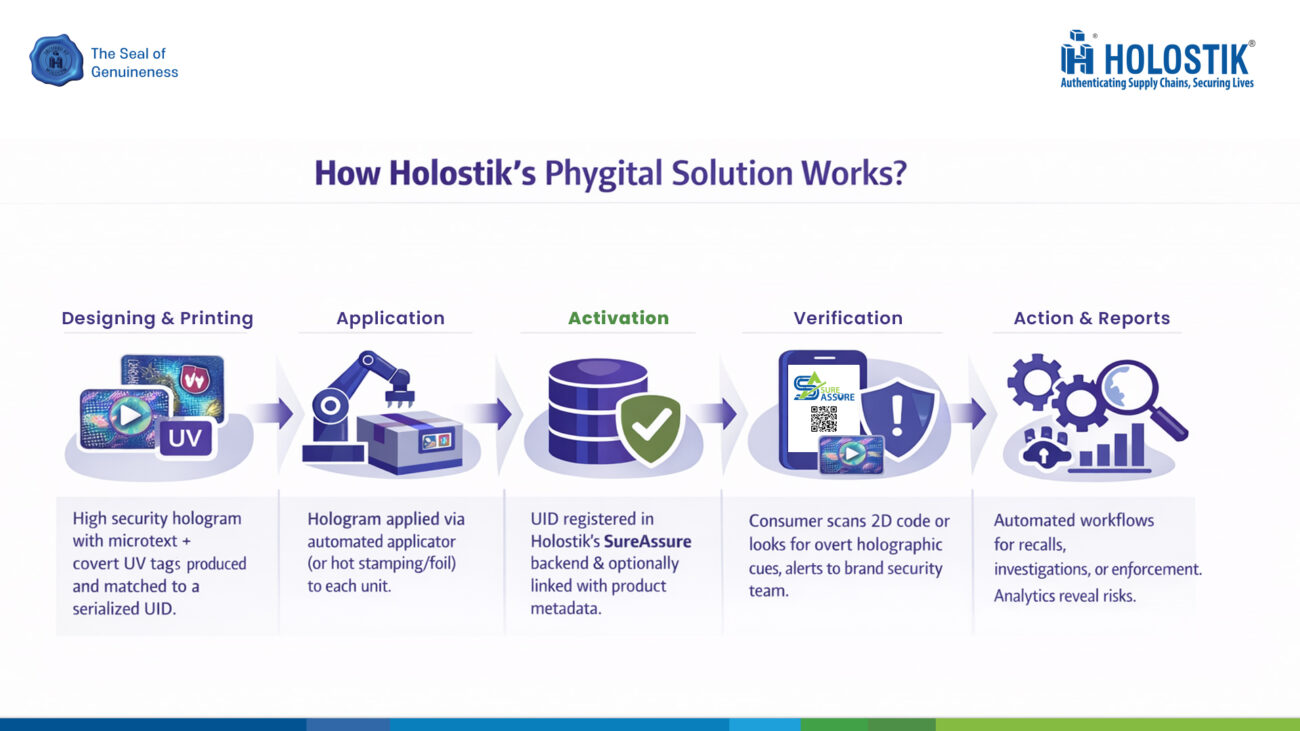
- High security: Often serialized or combined with track-and-trace codes (2D codes, UIDs) and connected to back-end systems for authentication, warranty, and recalls.
Our Digital Security Solutions can pair a hologram with digital verification, turning physical security into actionable data.
5. Tamper resistance & application method
High security holograms can be part of tamper-evident systems (destructible labels, tamper-resistant sleeves, shrink sleeves with security holograms) — they not only indicate fakes but also protect the integrity of sealed products.
Why industries choose high security holograms (real-world value)
- Pharmaceuticals: Protect patient safety and comply with anti-counterfeiting regulations.
- Liquor & luxury goods: Prevent revenue loss and protect brand reputation.
- Government / documents: Provide legal evidence and fraud resistance for IDs, licenses, certificates.
- Automotive & electronics: Authenticate spare parts and prevent dangerous counterfeit components.
Holostik Advantage — Physical + Digital (Phygital) Security
Holostik is not only a hologram manufacturer — it’s a turnkey anti-counterfeiting partner offering:
- Advanced hologram design & manufacturing — overt, covert and forensic features tailored to your risk profile.
- Speciality products such as Paper Hologram, Optashield, Rolling Optics and Checko for particular use-cases where substrate or application differs.
- Tamper-evident options including shrink sleeves and destructible labels for secure packaging.
- Digital Security — SaaS products like SureAssure for serialization, consumer/SKU level authentication, warranty and recall management, and integration with ERP/CRM systems.
- End-to-end implementation — Holostik works with hardware vendors (printers, applicators, vision inspection) to ensure secure, scalable deployment.
Why this matters: A hologram alone may deter casual counterfeiters. Combined with Holostik’s digital authentication and supply chain integration, you get real-time visibility, consumer-friendly verification, and the ability to act on counterfeiting incidents.
How a Holostik phygital solution works?
Holostik Impact
Holostik’s client outcomes (marketing figures used for campaigns) highlight measurable business impact:
- Up to 41%* increase in product sales for some implementations.
- 90%* drop in duplication incidents after deployment of combined physical + digital solutions.
- 339%* ROI reported on anti-counterfeiting projects.
- 100%* supply chain visibility where serialization and scanning were deployed.
How to choose between regular & high security holograms?
- Assess risk: If product counterfeiters create health/safety risks (pharma, auto parts), default to high security.
- Consider volume & cost: High security holograms cost more per unit but protect revenue and reputation — calculate ROI, not just sticker price.
- Regulatory needs: For regulated industries, use high security holograms to comply and to have legally defensible authenticity.
- Integration plans: If you need supply-chain visibility or consumer verification, choose a phygital solution (hologram + digital backend).
- Application environment: For harsh environments (outdoor, chemicals), pick a durable high security substrate and robust adhesives.